Abu Simbel at sunrise is worth the 4 am alarm, and this is exactly how the morning goes
Abu Simbel at sunrise is worth the 4 am alarm, and this is exactly how the morning goes
Abu Simbel at sunrise is the best hour of a trip through southern Egypt, and it happens every day of the year, not only on the two famous alignment dates. The Great Temple faces east over Lake Nasser, so the first sun hits the four seated colossi of Ramses II head on and turns the sandstone from gray to honey in about twenty minutes. To be standing there for it you leave Aswan by road around 4 am, take the short domestic flight, or sleep in Abu Simbel town and walk in at opening. The road is the classic choice, and the desert dawn from the vehicle is part of the reward.
Why the facade lights up at dawn, every day of the year
Ramses II had the temple cut into a cliff with its facade facing east across the Nile. When the temples were sawn into blocks in the 1960s and rebuilt on higher ground to escape the rising lake, the engineers kept that orientation almost exactly, so the four colossi still look straight at the point where the sun comes up over the water.
The rest is physics. The sun rises behind you as you stand in the forecourt, and its first flat rays strike the facade before anything else. For a few minutes the statues glow while the cliff around them is still in shadow. Then the color deepens, the carving throws sharp shadows, and by the time the sun is a hand's width above the horizon the whole facade is lit like a stage. At midday the light is vertical, the carving goes flat and the forecourt is a furnace.
One distinction, because the two get confused: this daily glow on the facade is not the sun alignment inside the sanctuary, which happens on two fixed days a year and is covered further down.
Three ways to be there at first light
Abu Simbel sits about 175 miles (280 km) south of Aswan, near the Sudanese border, with open desert in between. There is no train, so you have three options, and each changes the morning.
| Option | How the morning goes | Who it suits | The trade-off |
|---|---|---|---|
| Road from Aswan | Pick-up around 4 am, 3 to 3.5 hours of desert, arrive as the sun comes up, two hours on site, back for a late lunch | Most travelers, anyone whose Nile cruise docks in Aswan | A very early alarm and a long day in a vehicle |
| Domestic flight from Aswan | Under an hour in the air, shuttle to the temples, two hours on site, fly back the same morning | Young children, limited mobility, tight schedules | You usually land after the first light, with the buses already there |
| Overnight in Abu Simbel town | Arrive the afternoon before, sunset at the temples, the sound and light show, in at opening next morning | A spare night, photographers, second-time visitors | A small town with few hotels and nothing else to do, which is the point |
Our honest ranking for the sunrise itself: overnight first, road second, flight third. For most itineraries the road wins on practicality, because it fits between a cruise arrival and a Philae afternoon without costing a night. If you are weighing the flight, see our guide to domestic flights in Egypt. Tickets, opening and the layout of the site are in our page on Abu Simbel tickets and how to visit, so this page stays on the morning itself.
The 4 am road from Aswan, hour by hour
This is the version most of our travelers do, so here is what it feels like.
- 3:30 am, the alarm. Dress warm in winter, light layers in summer. Take the breakfast box your hotel or boat packed; there is no coffee stop on the road.
- 4:00 am, pick-up. Your driver and Egyptologist guide collect you at the hotel or the dock, pass the High Dam and turn south onto the desert highway.
- 4:30 to 6:00 am, the desert. Two hours of straight, flat road with nothing on either side. Most people sleep. Try not to. Around the halfway point the eastern sky goes from black to deep blue to orange, and the sun comes up over the sand dead ahead.
- 6:45 to 7:15 am, arrival. The road ends at the parking lot beside Lake Nasser. Your guide handles the tickets while you stretch.
- 7:15 to 9:15 am, the temples. Two hours is right. Your guide explains outside, you go inside on your own, then the Small Temple and the lake shore.
- 9:30 am, the return. Back across the desert and into Aswan around 1 pm, with the afternoon free.
Over the years the road has run in organized convoys, in fixed departure windows, and freely. We confirm what applies the week before, which is why the pick-up time can shift by half an hour.
Arriving before the crowds, and the walk around the rock
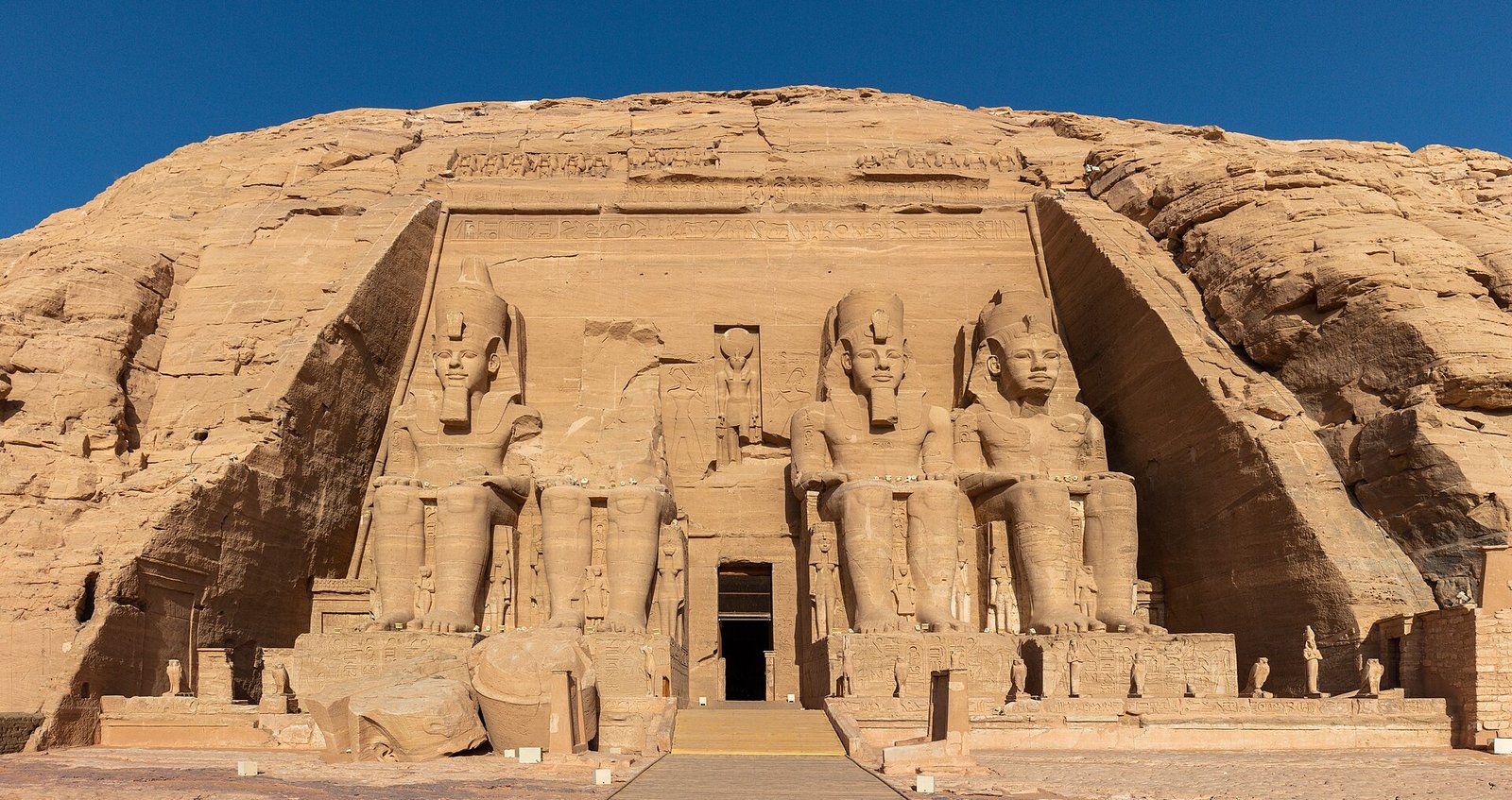
You cannot see the temples from the parking lot. A paved path follows the shore of Lake Nasser and curves around the back of an artificial mountain, a concrete dome covered with rock and sand that holds the relocated temples. Then the path bends and the Great Temple appears all at once: four seated figures of Ramses II, each about 66 feet (20 m) high, staring over the water. Every guide we work with stops the group at that bend, and every group goes quiet. Save the first look for the curve.
Your arrival time decides how many people share that moment. In the first half hour after opening the forecourt might hold a few dozen visitors; ninety minutes later it can be several hundred. Use those first thirty minutes for the outside. Walk the full width of the forecourt, then go down toward the lake and look back so both temples sit in one frame with the water in front. That is the photograph people end up printing.
The Great Temple of Ramses II, read from the forecourt
Stand in the center and read the facade like a page. The four colossi are the same king, seated with his hands on his knees, wearing the double crown of Upper and Lower Egypt. Beside the thrones stand much smaller figures of his family, including Queen Nefertari. That difference in scale is the whole message: the king as a god, the family as mortals.
The second colossus from the left has lost its upper body. It broke off in an earthquake in antiquity, and when the temple was moved the engineers laid the fallen head and torso back at its feet, exactly where they had lain for three thousand years.
Above the doorway stands the falcon-headed sun god Ra-Horakhty, and along the very top of the facade runs a row of baboons with their paws raised. Baboons chatter at dawn, and the Egyptians read that as the animals greeting the rising sun. With the real sun coming up behind you, the carving makes sudden sense. Along the base of the thrones are rows of bound prisoners, Nubians on one side and Asiatics on the other, and the raking dawn light is the only time of day you can read them clearly.
The Small Temple of Nefertari and Hathor
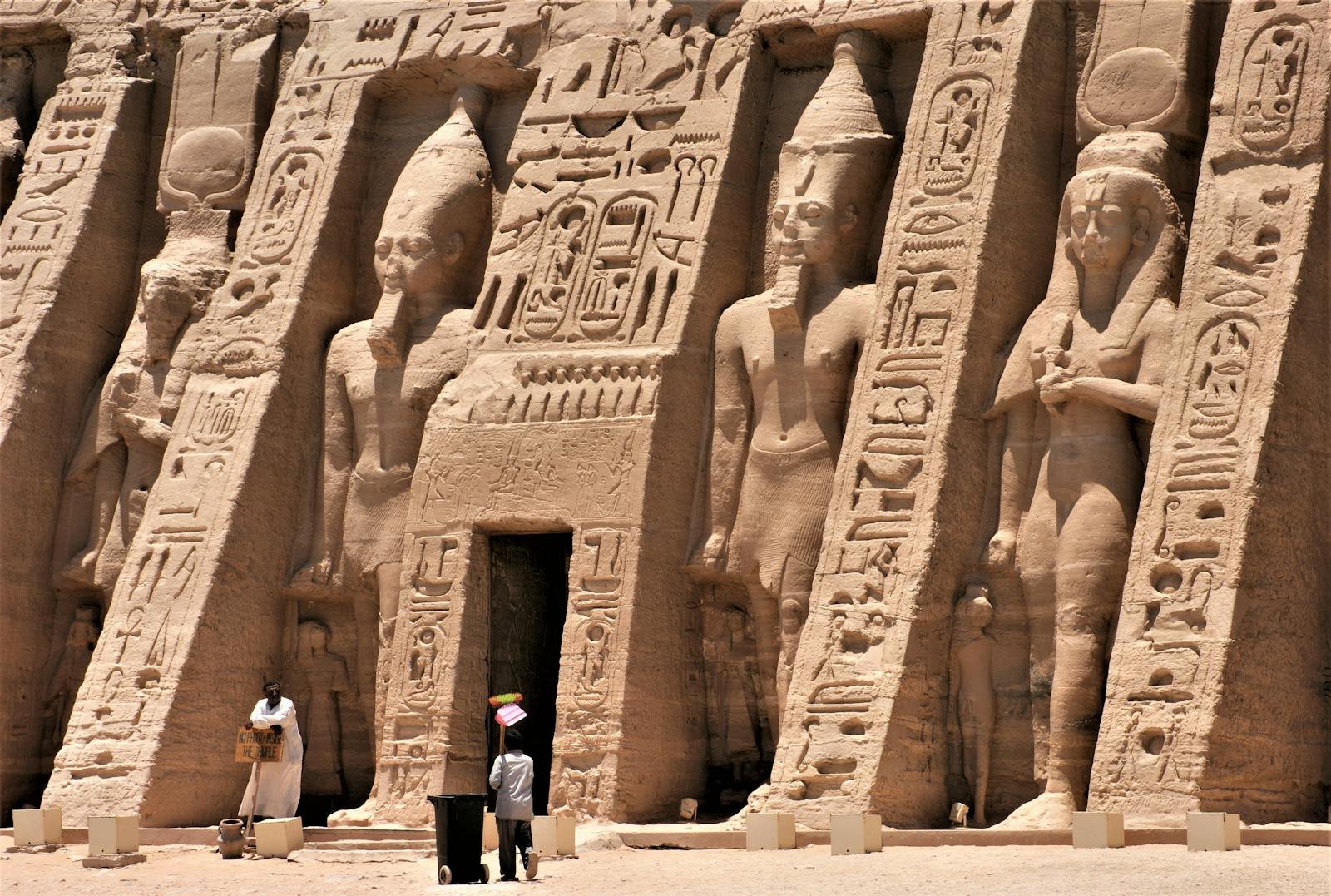
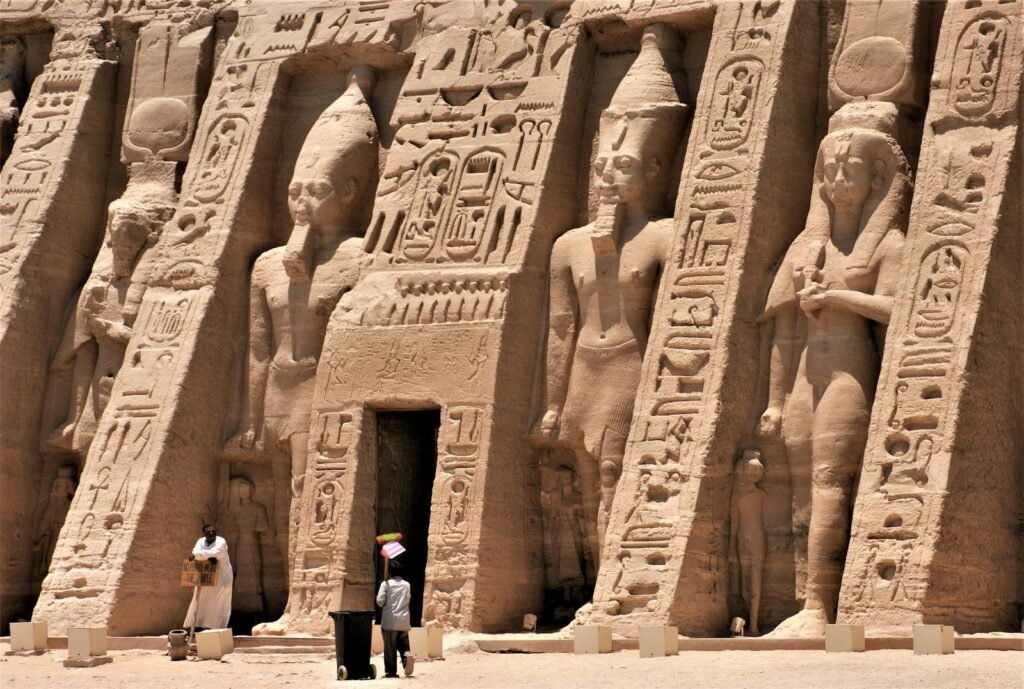
About 300 feet (100 m) to the north stands the second temple, dedicated to the goddess Hathor and to Ramses' chief wife, Nefertari. Its facade holds six standing figures roughly 33 feet (10 m) tall, four of the king and two of the queen, carved at the same height as him. In Egyptian royal art a wife was usually shown knee-high to her husband, so this is one of the very few places where a queen stands as an equal. The inscription over the door says he built it for the wife "for whom the sun shines". Given what the sun has just done, it lands.
Inside, six pillars carry the face of Hathor, the cow-eared goddess of love and music, and the wall scenes show Nefertari taking part in the rituals beside her husband. Most groups spend ten minutes here. Give it twenty; by mid-morning it is the emptier temple.
Inside the Great Temple: the halls and the sanctuary
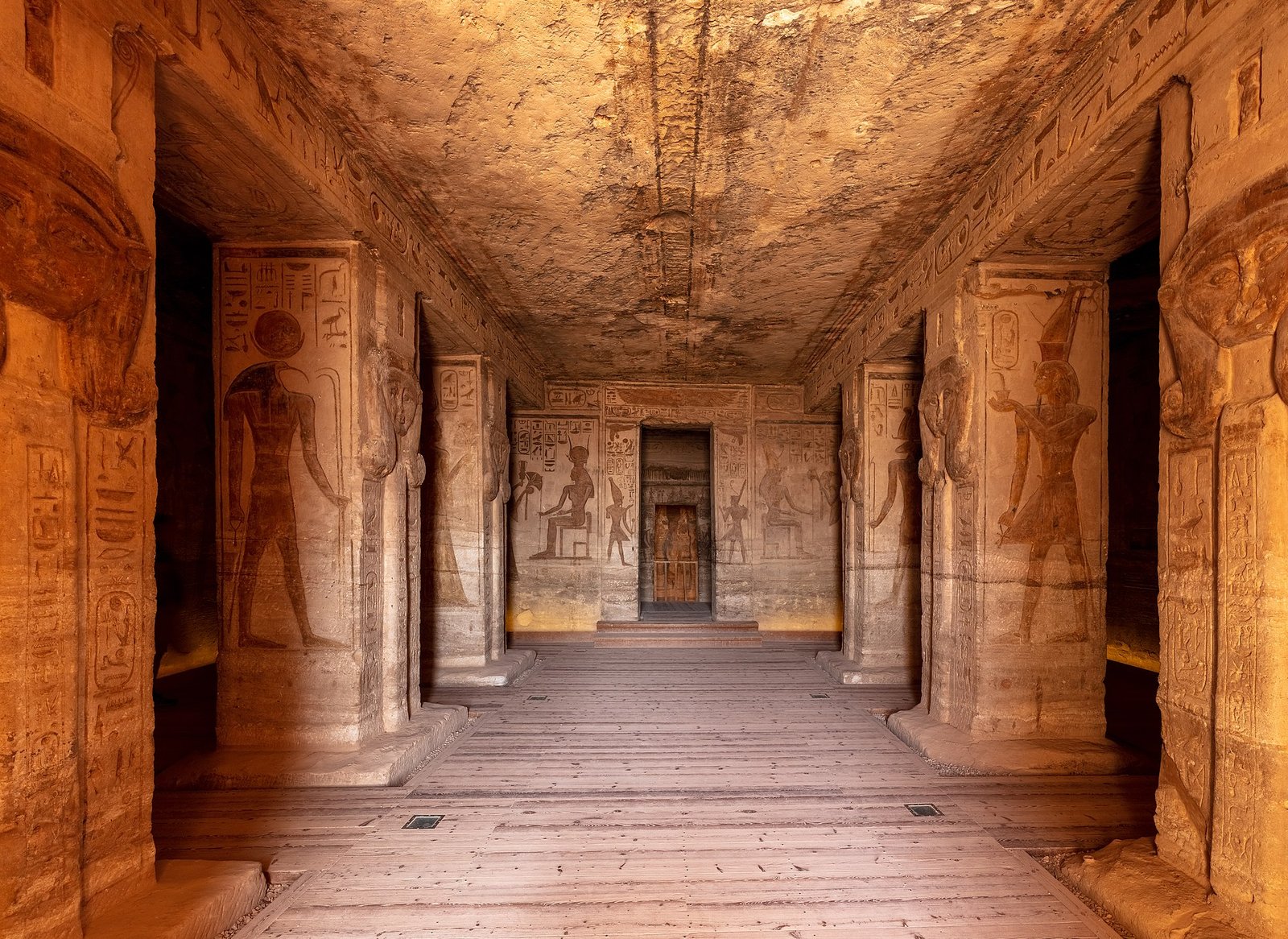
The Great Temple runs about 200 feet (60 m) straight back into the rock through rooms that get smaller, lower and darker as you go, from the world of the living toward the home of the gods.
The first hall
Eight huge pillars, each fronted by a standing Ramses as Osiris, hold up a ceiling painted with vultures. The walls carry the famous account of the Battle of Kadesh against the Hittites: chariots, a river, a camp under attack, and Ramses at full size firing arrows into a crowd of enemies, told left to right like a graphic novel.
The sanctuary
Past a smaller hall with quieter offering scenes, a chamber at the very back holds four seated statues cut from the rock wall: Ptah of Memphis, Amun-Ra of Thebes, the deified Ramses himself, and Ra-Horakhty of Heliopolis. On the two alignment mornings the sun reaches three of them and leaves Ptah, a god of the underworld, in the dark. On every other morning the sanctuary is lit by a lamp and you can stand in front of the four for as long as you like with no line. For many of our travelers that beats the festival. Flash is never allowed inside.
The sound and light show, the evening alternative
If sunrise is not for you, or you want both, there is an evening version. After dark the facades of both temples become a screen for a sound and light show, with narration through headsets in several languages and the story of the temples and their rescue projected across the colossi, Lake Nasser black behind them. The catch is geography: the road back to Aswan is not something you do at night, so seeing the show means staying in Abu Simbel town. That is why almost nobody sees it.
The town is Nubian, low-rise and quiet, on a headland above the lake, with a few hotels and guesthouses. A night here turns a rushed visit into a stay: the temples at sunset with the last buses gone, the show, dinner by the lake, and the gate at opening next morning with the road travelers still an hour away. Show timings vary with the season, so we confirm them for your dates. Our Abu Simbel 2-day tour is built around this overnight.
The two sun alignment days, briefly
Twice a year, on February 22 and October 22, the rising sun reaches all the way down the axis of the Great Temple and lights the statues in the sanctuary. The dates are fixed and celebrated as a festival, with Nubian music and dancing in the forecourt from before dawn and a crowd many times the usual size.
The alignment mornings are a cultural event with long lines and timed entry to the sanctuary; the ordinary sunrise is a quiet morning with the facade to yourself. Both are good and they are not the same thing. If you want the festival, plan far ahead, because the town's few beds go first. It has its own guide, the Abu Simbel Sun Festival, with what actually happens and how to be there.
Cold dawns in winter, hot ones in summer
The most common mistake on this trip is packing for Aswan's daytime and forgetting that you will be outdoors in the desert before sunrise, in the lake wind.
| Season | At 5 am in the desert | By 9 am in the forecourt | What to wear |
|---|---|---|---|
| December to February | Around 45 to 50 F (7 to 10 C), colder in the wind | Around 65 to 75 F (18 to 24 C) | A fleece or light jacket, a scarf, long pants, then peel down |
| March, April, October, November | Around 55 to 65 F (13 to 18 C) | Around 80 to 90 F (27 to 32 C) | A long-sleeved layer over a T-shirt |
| May to September | Around 75 to 82 F (24 to 28 C) | Well over 100 F (38 C) by mid-morning | Light, loose, pale clothing and a hat; back in the vehicle before 10 am |
These are typical ranges from our own mornings on the road, not forecasts. Our page on the best time to visit Egypt sets the sunrise trip in the context of the whole year.
What to bring for the sunrise trip
- A warm layer in winter, however warm Aswan felt at dinner. You take it off by 8 am.
- Water from Aswan. The cafe near the entrance has a long line once the buses arrive.
- Sunglasses, a hat and sunscreen. The forecourt has no shade, and by 9 am you face a low sun reflecting off sandstone and water.
- Comfortable closed shoes. The walk around the rock and back is about a mile, with steps at the temple entrances.
- A spare camera battery. Cold drains batteries, and the best light lasts twenty minutes.
- Your passport, for the checkpoints on the southern road, and small cash for the restroom attendant.
For the rest, our guide on what to pack for Egypt covers the whole trip.
How Explora Egipto runs the sunrise trip
We are a local agency in Egypt with our own vehicles, drivers and Egyptologist guides, so we run the Abu Simbel morning ourselves rather than resell it. In practice:
- Private vehicle, your own guide. No shared minibus doing four hotel pick-ups before it leaves Aswan.
- A departure time set for your date, adjusted for the season's sunrise and the road arrangement in force.
- The explanation outside, the silence inside. Our guides talk in the forecourt and let you walk the halls alone.
- The rest of the day planned around it. Back in Aswan by early afternoon for Philae Temple, a felucca at sunset, or the boarding time of your Nile cruise.
- The overnight version when you have the night to spare, with the sunset visit, the show and the second morning at opening.
The day-trip version is our Abu Simbel day trip from Aswan. Tell us your dates and we send you the quote.
Frequently asked questions
Does Abu Simbel really light up at sunrise every day?
Yes. The Great Temple faces east across Lake Nasser, an orientation the engineers preserved when they moved it, so the first sun strikes the four colossi directly every morning of the year and the facade goes from gray to gold in about twenty minutes. This daily glow is separate from the sun alignment inside the sanctuary on February 22 and October 22.
What time do you leave Aswan to see Abu Simbel at sunrise?
Around 4 am, give or take half an hour depending on the season and the road arrangement on your date. The drive across the desert takes 3 to 3.5 hours, so you arrive as the sun comes up or shortly after, spend about two hours at the temples, and are back in Aswan around 1 pm with the afternoon free.
Is it better to drive or fly to Abu Simbel from Aswan?
For the sunrise itself, drive. The road gets you there for the first light and the desert dawn from the vehicle is a highlight of the day. The domestic flight is shorter and easier on the body, the better choice for small children or mobility concerns, but it usually lands you at the temples after the light has come up and the buses have arrived.
Can you stay overnight in Abu Simbel?
Yes, and we recommend it to anyone with a spare night. The town has a handful of hotels and guesthouses above the lake. Staying lets you see the temples at sunset when they are nearly empty, watch the sound and light show that day-trippers never see, and walk in at opening the next morning an hour before the road traffic arrives.
How cold is it at Abu Simbel at dawn in winter?
Cold enough to catch people out. On a December or January morning the desert at 5 am sits around 45 to 50 F (7 to 10 C), and the lake wind in the forecourt makes it feel colder. By 9 am it is a pleasant 65 to 75 F (18 to 24 C). Bring a fleece or light jacket and a scarf, and expect to take them off before you leave.
Is sunrise at Abu Simbel worth the early start?
Of everything on a classic Egypt itinerary, this is the morning people mention first when they get home. It is not only the size of the statues. It is crossing the desert in the dark, watching the sun come up over the sand, and walking around the rock to have the facade appear all at once, lit and almost empty. Sleep on the way back.
Be standing in front of Ramses when the sun comes up
Tell us your dates and whether you have a spare night, and we come back with the sunrise trip that fits: the road from Aswan with your own guide and vehicle, the flight if you need it, or the overnight with the show and the second morning at opening. We send you the quote.